Researching more environmentally friendly mouse and rat poisons
Unfortunately, many rat poisons also end up in the diets of wild predators, as well as in the stomachs of dogs and cats, and in the environment. Research is now underway to identify rodenticides that are equally effective but break down quickly in the environment, thereby reducing their harmful effects on non-target animals.
.jpg)
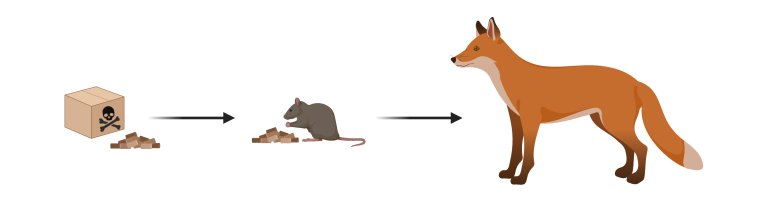
To control populations of rats and mice that cause damage, rodenticides with so-called anticoagulant effects (agents that thin the blood and prevent clotting) have been used worldwide for a long time. This type of rodenticide breaks down slowly and is poorly soluble in water. As a result, the poisons accumulate in ecosystems, poison other animals - particularly predators - and contaminate water and soil.
Previous studies carried out by the Norwegian Veterinary Institute and other research institutes have detected rodenticides in both birds of prey and predatory mammals. These animals are believed to have been exposed through the consumption of poisoned small rodents. There are also numerous examples of dogs and cats ingesting such rodenticides and, in the worst cases, being poisoned by them.
Seeking environmentally preferable alternatives
“In the GreenBait project, we are researching more environmentally friendly rodenticides that break down more quickly, so that they do not accumulate in the environment and cause harm to other animals,” says project leader and researcher Ingunn Anita Samdal at the Norwegian Veterinary Institute.

“We are examining several types of anticoagulant rodenticides that have been used on the Norwegian market.”
“Many of these rodenticides actually consist of four variants (of the anticoagulant compound) with the same two‑dimensional structure but different three‑dimensional structures. These variants, known as stereoisomers (molecules with identical formulas but different spatial arrangements), can have different properties, both in terms of toxicity (anticoagulant activity) and how readily they break down in the environment,” Samdal explains.
She adds that the project also aims to establish improved analytical methods to gain greater insight into the significance of the different anticoagulants. This includes identifying the individual variants of these rodenticides.
“We aim to identify the three‑dimensional variant that degrades most rapidly in nature, while still retaining its toxic effect,” she says. She adds that by evaluating and ranking rodenticides according to properties such as effective control of small rodents and rapid environmental degradation, the project will contribute to the development of gentler and more environmentally friendly rodenticides in the future.
Results to date
So far, the project indicates that some of these variants are less stable and more prone to change, while others are more persistent in the environment.
“When we have more knowledge about this, it will be possible to design rodenticides that specifically use only the variants that are toxic but degrade most rapidly in the environment,” she explains.
Improved monitoring and tests for faster detection
The project also aims to develop more user‑friendly tests. This includes developing antibodies that can be used in immunological tests such as ELISA and rapid tests (similar to coronavirus tests). Such tests will make it easier and faster to determine whether rodenticide exposure is the cause of a poisoning and will help veterinarians provide prompt and appropriate treatment.
Samdal also explains that, in collaboration with NIBIO, the project is studying how anticoagulants are transported through soil and broken down in the soil matrix.
“We are seeing differences in how the chemical substances in rodenticides break down in the different soil types that our project partner, NIBIO, has exposed to rodenticides,” she says. “In addition, we are investigating how different anticoagulant rodenticides are broken down in the liver of wild animals.”
%20(1).jpg)
Samdal explains that by combining statistical analyses of the entire dataset with risk assessments of adverse health and welfare effects on other animals, the project generates new insights and valuable information for authorities and stakeholders.
.jpg)
Poisons accumulate in wild animals
Wildlife health researcher and veterinarian Knut Madslien at the Norwegian Veterinary Institute refers, among other things, to a 2018 study of wild Eurasian eagle‑owls in Norway, which detected anticoagulant rodenticides in 72 out of 100 examined birds. Several of these birds had concentrations of toxic substances considered potentially harmful.
A similar study of liver samples from 254 wild Norwegian predators (wolf, lynx, wolverine, red fox, Arctic fox, and American mink), conducted in collaboration with NINA and the NMBU Faculty of Veterinary Medicine in 2019, detected toxic substances in a significant number of individuals across all examined predator species. Notably, 100% (51/51) of the red foxes had traces of these substances in their livers.
“The findings from these studies, which show that rodenticides are widely present in birds of prey and predatory mammals, highlight the need to identify alternative anticoagulant rodenticides that remain effective against small rodents but break down more rapidly in the environment.”
“The GreenBait project is a natural consequence of, and an important follow‑up to, these findings in wild animals,” says Madslien.
.jpg)
He adds that the Norwegian Environment Agency is now tightening regulations on the use of mouse and rat poisons by private individuals, partly based on research conducted at the Norwegian Veterinary Institute.