The Gut Microbiota can be a hidden Key to healthier Salmon
New research provides surprising insights into how bacteria in the salmon gut may hold the key to both improved fish farming and resilient wild salmon populations.
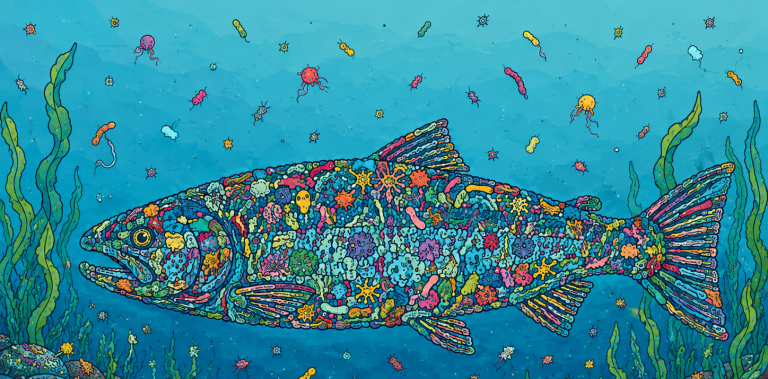
Salmon ends up on dinner plates around the world, but few people ever think about what is going on inside them, specifically, inside their gut, where a community of bacteria quietly goes about its business.
Much attention has been paid to how the composition and diversity of microorganisms in the gut play a significant role in human health. But what goes on in the digestive tract of salmon? Now, researchers have investigated the dynamics of the gut microbes in salmon from Norway, Scotland and Ireland.
Important for Norwegian industry
Farmed salmon is one of Norway's most important exports. A better understanding of the microbes in fish can help reduce disease and promote healthier fish, which in turn leads to more sustainable production.
Researchers behind the study have analysed a total of 847 samples of gut contents from Atlantic salmon (Salmo salar) along with their feed and environment (water). The analysed fish came from both freshwater phases to seawater phases and from farmed and wild salmon that eat different feed and grow in different environments.
Farmed salmon has lower bacterial diversity
The results reveal a clear difference between wild and farmed salmon, a distinction greater than many had thought.
“We saw that in farmed salmon; the diversity of bacteria is lower, and the composition is also different than in wild salmon. By comparison, we found that the bacteria in farmed salmon are more specialised and adapted to life in cages”, says Wasimuddin, researcher at the Norwegian Veterinary Institute and one of the lead authors behind the study.
This may sound effective, but it can also be a disadvantage, Wasimuddin explains:
“In nature, variety is often a strength. A rich diversity of bacteria is often associated with a robust immune system and greater resilience against diseases. When diversity shrinks, fish can become more vulnerable to diseases”.
Farmed salmon’s microbiota lose diversity as it grows
The study has revealed that when salmon grow, the bacterial diversity decreases. This phenomenon, showing that some types of bacteria disappear, while others dominate, is consistent with ecological succession toward a more host- and diet-filtered gut community. This is a pattern that has also been reported in earlier studies (https://doi.org/10.1128/AEM.02283-19). The analyses point to one type of dominating bacteria in particular: Mycoplasma. It is found in greater quantities in salmon and seems to "take space" from other bacteria.
“It is a genus of bacteria that has co-evolved with salmon over millennia, essentially becoming a dominant gut bacteria”, Wasimuddin adds.
So, what does this mean in practice? The researchers say they don't know yet. This is one of the big gaps in knowledge that the study reveals. But they suspect that such changes could affect both the health and growth of the fish.
Type of feed could influence fish health
Particularly what the salmon eats, stands out as the most important factor. The study demonstrated that around 23 percent of the variation in the bacterial flora in farmed salmon can be explained by diet alone. Farmed salmon are fed standardised feed, while wild salmon eat a varied diet in the wild. This results in different bacterial communities. Because the gut microbiome has been linked to disease resistance and stress response in fish more broadly, the finding that diet has such a strong influence on gut bacteria raises the possibility that feed choices could indirectly affect how robust farmed salmon are.
The study also points to how the environment around the fish also plays a role – but the effect varies from region to region and throughout its life cycle.
“This is important knowledge for the aquaculture industry. Because the bacteria in the gut are not just passengers. They influence how robust the individual is against disease and stress”, Wasimuddin explains.
Can make farming more sustainable
The findings point to something very central: Farming practices can be improved by taking intestinal bacteria into account. The right feed and a better environment can result in healthier fish – and more sustainable production. Thus, getting the right microbiome is not just a scientific curiosity; it is an economic imperative.
At the same time, the researchers send a clear warning. It is important to preserve the rich bacterial diversity of wild salmon. This diversity can be crucial when the fish face new challenges in a changing environment. Protecting wild salmon populations is not just a conservation goal; it is a way of preserving their unique microbial diversity, a biological resource whose value for fish health and resilience we are only beginning to understand.
Could become a new "health check" tool
The study also provides an important tool for the future. Gut microbiome monitoring is increasingly being explored as a way to gauge animal health, for example, tracking shifts in microbial community could offer an early signal of trouble before other symptoms appear. The researchers have created a kind of baseline for what the gut bacterial flora of wild salmon looks like across areas.
Wasimuddin explains that a tool like this can be used to track environmental impacts, detect stress and disease in fish, and monitor the health of wild salmon populations. The concept can also be extended to other fish species as well. In short, monitoring the bacteria in the gut can act as an early warning signal.
What happens next?
The researchers emphasize that they need to go further with the study. Knowing which bacteria are present is only a first step. “Now we want to go deeper and find out how the different bacteria in the gut and also those residing on skin and gills actually work within the fish body”, Wasimuddin explains and points to questions they are looking for answers to: How do they affect the immune system, how do they interact with each other, and how do they influence fish health overall?
By combining new methods that map the function of the bacteria - and not just what they are - the researchers hope to find answers.
"If the industry puts this knowledge of the salmon gut to use, it could generate positive ripple effects far beyond the confines of the fish cage," Wasimuddin concludes.
This work is an output of the CIRCLES (EU) projecton food s ystems microbiomes, where the Norwegian Veterinary Institute led the work on salmon.
Read full article: Ecological dynamics of the Atlantic salmon gut microbiota across developmental phases and geographic regions | Communications Biology