In search of a deadly bacterium
In a new film, you can follow researchers and fish farmers as they hunt for infectious bacteria that make farmed salmon ill – so ill that the fish can die. Can we save them?
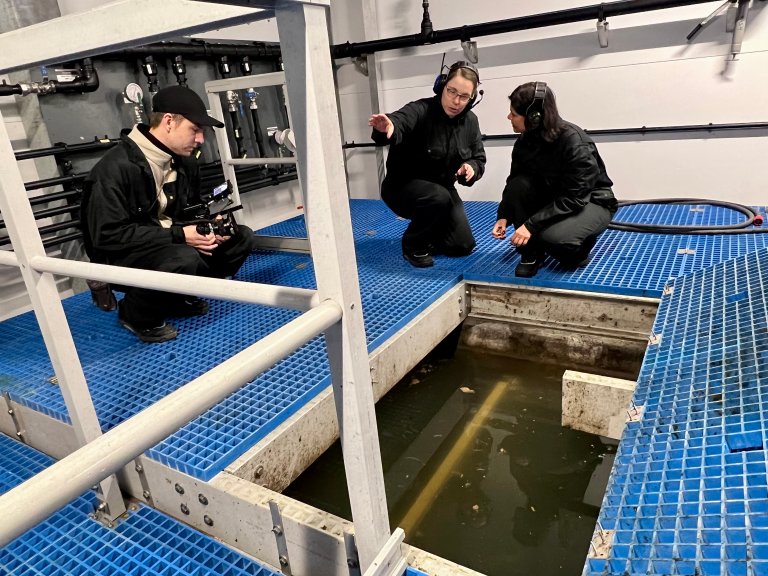
The setting is a recirculating aquaculture facility for salmon smolt in the Hardangerfjord on Norway’s west coast. The villain is the bacterium Candidatus Branchiomonas cysticola — hiding in kilometres of pipes, pump systems and large tanks. After discovering the bacterium, the fish farmers initiate a unique collaboration with researchers from the Norwegian Veterinary Institute to stop the outbreak.
When the farmers identified diseased fish and confirmed the culprit, they quickly received help from the Norwegian Veterinary Institute to implement measures to reveal where the bacterium was hiding. In the film, we see industry and research partners working together to test how to locate and eradicate the bacteria — checking results in the laboratory before testing again at the facility. Are the bacteria now completely gone, or do they still threaten the fish?
A focus on One Health
The new short film from Norway, Tracing the Invisible Threat, is part of the series Animals & Us, which focuses on One Health and is presented by the World Organisation for Animal Health (WOAH). It was produced for the EU Partnership on Animal Health and Welfare (EUPAHW) by BBC StoryWorks Commercial Productions. This film shows how meticulous and systematic work in research, diagnostics and innovation underpins the hunt for deadly bacteria in complex, land-based aquaculture system. The story is narrated by production manager Signe Jordal from the Ænes Inkubator AS facility close to Rosendal at the West-Coast of Norway and senior researcher Sonal Patel from the Norwegian Veterinary Institute in Bergen. EUPAHW is a major European project uniting scientists, veterinarians, authorities, and funders to improve animal, human, and environmental health.
The series is now being launched on the BBC website. In total, the series includes 12 branded mini-documentaries on international research collaboration in animal health and welfare—and how such health threats can affect humans. The film from Norway is one of the three films produced for EUPAHW are accessible on the EUPAHW dissemination channels.
Robust biosecurity is key
Research on biosecurity in land-based recirculating aquaculture systems is the result of many years of work that is still ongoing, now continued within the framework of the EU’s EUPAHW network in a research project led by the Norwegian Veterinary Institute. It is no surprise that Norwegian research communities are leading the work on health and welfare in aquaculture. The EU project builds on previous and ongoing activities led by the Norwegian Veterinary Institute and Akvaplan-NIVA through Norwegian research funded by the Norwegian Seafood Research Fund (FHF), Biosecurity in RAS. The Norwegian research project, led by NIVA, includes several research institutions and industry partners from Norway.
“The film demonstrates how important robust biosecurity and well-thought-out measures are necessary to protect fish in aquaculture facilities against disease, and is based on research and knowledge about disease-causing agents such as viruses and bacteria. It is inspiring to collaborate in this way with industry, and then to share and further develop advanced knowledge on biosecurity in such facilities with partners across Europe and the rest of the world,” says senior researcher Sonal Patel.
“It has been so exciting, truly rewarding and fun to make this film together with the skilled people at Ænes Inkubator and the professionals from BBC StoryWorks. I never anticipated the meticulous planning and time that goes in production, and will always cherish this experience,” she adds.