The National Veterinary Institute (NVI)

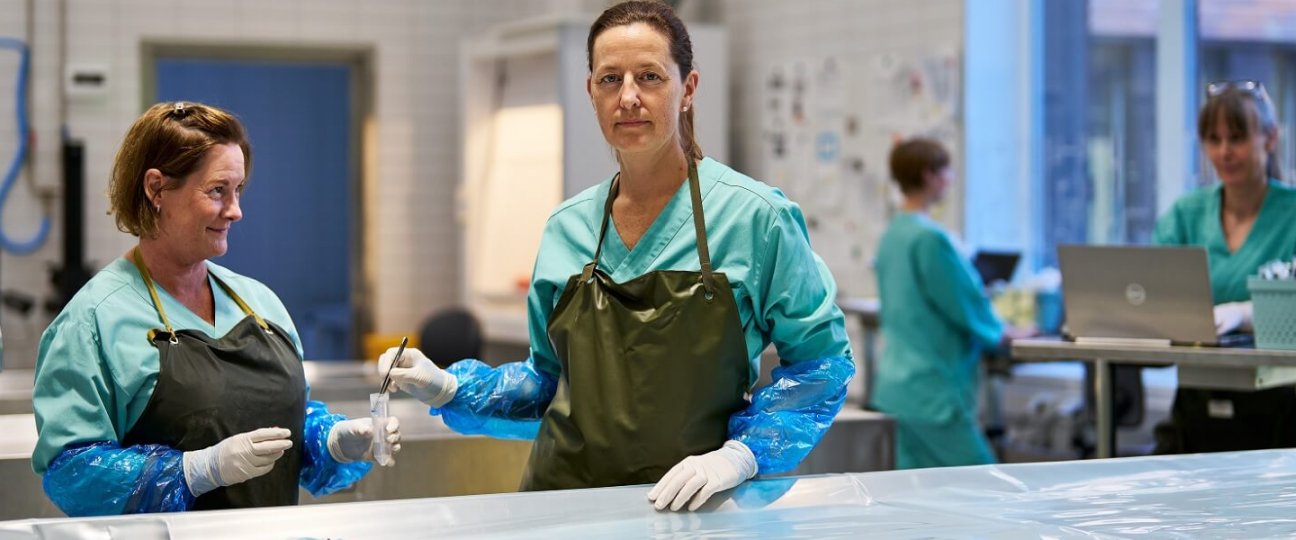
The National Veterinary Institute is a national biomedical research institute in the fields of animal health, fish health and food safety, whose primary function is supply of independent research based advisory support to the governing authorities.

Preparedness, diagnostics, surveillance and monitoring, reference- and scientific advisory functions, and risk assessment are the most important areas of operation. The National Veterinary Institute has its central laboratory in Oslo, with regional laboratories located in the cities of Sandnes, Bergen, Trondheim, Harstad and Tromsø.

The National Veterinary Institute is a governmental agency, funded by the Ministry of Agriculture and Food, Ministry of Fisheries and Coastal Affairs and the Norwegian Research Council. The Ministry of Agriculture and Food owns properties and buildings from which the National Veterinary Institute operates, while the National Veterinary Institute has responsibility for maintenance. The buildings are in good condition and the laboratories modern.

The institute’s products and services are research results and reports, analyses and diagnostics, scientific evaluations and advices within the main fields of operation.

News

Helth situation in farmed Norwegian fish 2009

The health situation in farmed salmonids in Norway is relatively good, but there remain considerable losses as a result of many diseases, of both known and unknown cause. The existence of so many diseases of unknown cause, and the annual appearance of new diseases, make disease diagnostics especially challenging. There are no significant changes in the disease situation in farmed marine fish species. The majority of samples submitted are from cod, with the remainder from halibut, wrasse, turbot and other species.

Bluetongue: new results

Analyses of new bulk milk samples has revealed four new herds that needs to be followed up with blood sample analyses. The National Veterinary Institute presented the results for the Norwegian Food Safety Authorities wednesday evening.

New research project on transmission routes and infection dynamics for salmonid alphavirus (SAV)

Outbreaks of pancreas disease, PD, cause large economic losses for the salmonid farming industry in northern Europe. The geographical area in which PD occurs in Norway has increased significantly in recent years. A research project with the aim of investigating how the causal virus, SAV, is dispersed within and between sites, was recently started. The

New Publications

"Gyrodactylids (Gyrodactylidae, Monogenea) infecting Oreochromis niloticus niloticus (L.) and O. mossambicus (Peters) (Cichlidae): A pan-global survey"
Garcia-Vasquez A, Hansen H, Christison KW, Rubio-Godoy M, Bron JE, Shinn AP. ACTA PARASITOLOGICA 2010; 55 (3): 215-29
"First case of babesiosis caused by Babesia canis canis in a dog from Norway"
Øines Ø, Storli K, Brun-Hansen H. VETERINARY PARASITOLOGY 2010; 171 (3-4): 350-3
"Pancreas disease (PD) in sea-reared Atlantic salmon, Salmo salar L., in Norway; a prospective, longitudinal study of disease development and agreement between diagnostic test results"
Jansen MD, Wasmuth MA, Olsen AB, Gjerset B, Modahl I, Breck O, Haldorsen RN, Hjelmeland R, Taksdal T. JOURNAL OF FISH DISEASES 2010; 33 (9): 723-36
"Influence of storage temperature on gene expression and virulence potential of Listeria monocytogenes strains grown in a salmon matrix"
Duodu S, Holst-Jensen A, Skjerdal T, Cappelier JM, Pilet MF, Loncarevic S. FOOD MICROBIOLOGY 2010; 27 (6): 795-801
"Genetic diversity and prevalence of netB in Clostridium perfringens isolated from a broiler flock affected by mild necrotic enteritis"
Johansson A, Aspan A, Kaldhusdal M, Engstrom BE. VETERINARY MICROBIOLOGY 2010; 144 (1-2): 87-92

Se flere